 Origins
& Early History of Windups
W
i n d u p s . c o m
Antique
toys and vintage windups: clockwork mechanical toys with magic.
Please note this domain is for sale.
If you are interested in purchasing the domain name windups.com we are selling
it.
Contact us at info@windups.com if you
would like this domain name for your business or project.
Origins
& Early History of Windups
Wind-up toys descend from ‘automata’ — mechanical figures that simulate life — which have been described since antiquity. Hero of Alexandria designed clockwork birds during the Hellenistic period. The most famous early example is Leonardo da Vinci's mechanical lion, reportedly presented to King Francis I in Lyon in 1515. In the 18th century, Jacques de Vaucanson built his celebrated ‘Digesting Duck’ (1738), which could eat, drink, quack, and swim. Swiss watchmaker Pierre Jaquet-Droz created three animated dolls — ‘The Musician’, ‘The Draughtsman’, and ‘The Writer’ — that performed intricate, lifelike actions.
Mass Production Era
The shift to affordable toys came in the ‘‘late 19th century’’ with advances in sheet-metal stamping and tin lithography:
- Gebrüder
Bing - Germany - Pioneered lithographed tin toys c. 1880
- Ernst Paul Lehmann - Germany - Intricate tin animals, vehicles, dancers (from 1887)
- Lucien Bontemps - France - Affordable painted-tin clockwork figures
- Schuco - Germany - Founded 1912; elaborate mechanical designs
- Louis Marx & Co. - USA - Licensed character toys (Mickey Mouse, Popeye, Porky Pig) from 1934;
sold 8 million wind-ups in its first year (1921)
- Tomy - Japan - First ‘‘plastic’’ wind-up toy in 1977 (Rascal Robot)
- Masudaya - Japan - Post-WWII affordable tin wind-ups for export
German and French makers dominated through the 1920s–30s; Japanese firms (Tomy,
Masudaya, Alps, Bandai) took over global supply after WWII.
How the Mechanism Works (in Detail)
The full chain from hand to motion:
1. ‘‘Mainspring’’ — A flat
strip of high-carbon spring steel coiled inside a cylindrical housing. Turning
the winding key tightens it around a central ‘‘arbor’’, storing potential energy
through elastic deformation.
2. ‘‘Ratchet & Pawl’’ — A spring-loaded pawl clicks into angled teeth on
a ratchet wheel, locking the spring in place while winding and preventing back-rotation.
3. ‘‘Gear Train’’ — A series of meshed gears transmit torque from the spring.
Smaller ‘‘pinions’’ increase speed; larger ‘‘escape wheels’’ reduce it. The
ratio determines how fast the output shaft turns.
4. ‘‘Speed Regulation’’ — Without this, the spring would dump all its energy
in a fraction of a second. Two common approaches:
- ‘‘Escapement’’ (e.g., "runaway escapement"): a
rocking ‘‘pallet’’ alternately locks and releases teeth on the escape wheel,
metering energy in small, rhythmic bursts — the same principle as a clock's
tick-tock.
- ‘‘Centrifugal governor / air fan’’: rotating weights or blades
expand outward with speed, creating speed-dependent drag that automatically
brakes the mechanism as it accelerates. This is the most common type in cheap
wind-up toys and music boxes.
5. ‘‘Cams, Cranks & Linkages’’ — Convert the steady rotary output into the
specific action: a ‘‘cam’’ (an eccentric lobe on a rotating shaft) pushes a
‘‘follower’’ up and down to make a head nod, a tail wag, or a leg step. A ‘‘crank’’
in a slot rocks legs back and forth. These are what give each toy its distinctive
"personality."
Types & Categories
- ‘‘Figural / Animal toys’’
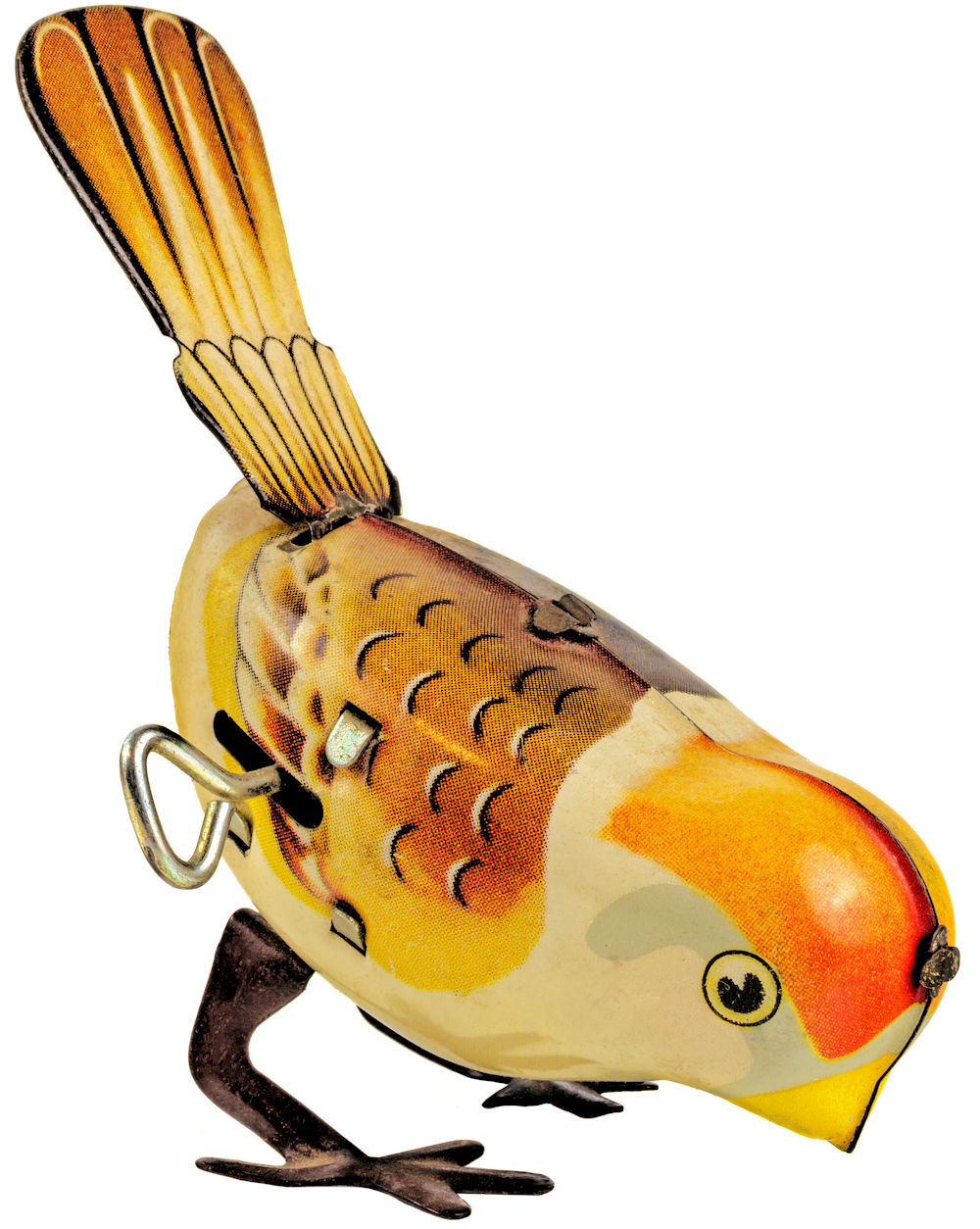
— Walking dogs, jumping frogs, pecking chicks, dancing sailors. Cams drive the
repetitive limb motions.
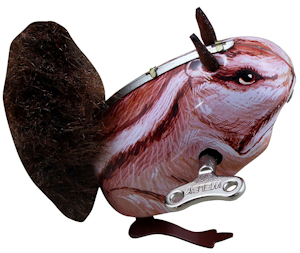
- ‘‘Vehicles’’ — Märklin produced the first system railroad in 1891 with wind-up
locomotives. Cars, boats (e.g., Bowman's clockwork cabin cruisers), and airplanes
followed.
- ‘‘Character toys’’ — Licensed figures like Mickey Mouse (Marx, 1950s), Popeye
(Linemar, Japan), and Shogun Warriors (Bandai, 1970s).
- ‘‘Musical toys’’ — Music boxes and singing birds, where the governor (usually
an air fan) keeps tempo constant.
Modern Revival & Collectibility
The rise of injection-molded plastics and cheap alkaline batteries in the 1950s–60s caused a steep decline, but a ‘‘collectors' market’’ has persisted: a Lehmann tin wind-up van (model #595, c. 1907–1935) sold at auction for ‘‘$1,305’’. In the 2010s, California Creations launched the ‘‘Z Wind-Ups’’ line — translucent plastic toys (Noggin Bops, Amazing Animals) that expose the internal gears, blending mechanical transparency with child-safe materials for a new generation.
 |
 |
 |
 |
Windups.com
is a participant in the Amazon Services LLC Associates USA Program, an American-based
affiliate advertising program designed to provide a means for sites to earn
advertising fees by advertising and linking to the Amazon.om marketplace.
Some product description, photographs and reviews and other various content
that appears on this website comes from Amazon Services LLC.
This content is Provided 'AS IS' and is subject to change or removal at any
time.
2027 © windups.com
email can be sent to info @ this domain